
Order Menopause & Perimenopause Treatment Online
Commonly treated with Estradiol & Progesterone
Medication as Low as $25.00


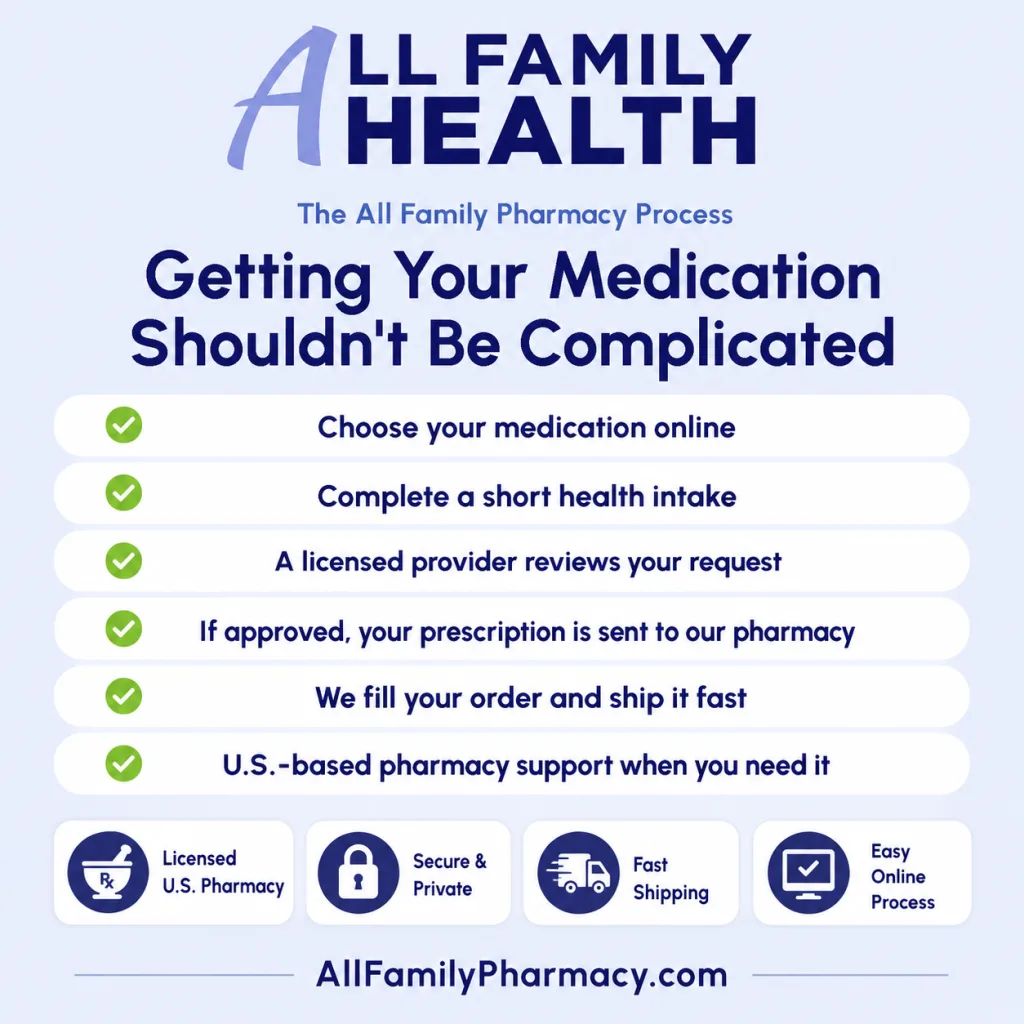
How It Works
- Step 1Choose TreatmentSelect your treatment and quantity.
- Step 2Complete Health QuestionsAnswer a brief medical intake.
- Step 3Provider ReviewA licensed provider reviews your information.
- Step 4Pharmacy ShipsIf approved, your prescription is filled and shipped.
What patients say
“So far very easy to use and good explanation”
“I LOVE being able to order online prescriptions as needed.”
“I have used All Family Health many times and have never been disappointed. They offer great service and great products.”
“Professional and secure. Safe and efficient process. Thank you!”
“Great Pricing and a great product”
“My order was very easy. Thank you.”
“Very easy to navigate the site”
“Prompt, professional organization.”
“Everything was so simple to do,I can't not be more happy with your business 😁”
“I'm happy I was able to get what I was looking for”
- A one-time provider review fee is added once per order, not per medication
- Transparent pricing with no surprise fees
- Packed and shipped in plain, unmarked packaging
- You only pay if a provider approves your order
- Eligible for HSA and FSA
Choose Your Treatment *
+ $30 provider review & $10 shipping
Refill up to 3 times without a new visit — fast processing.
+ $30 provider review & $10 shipping
Refill up to 3 times without a new visit — fast processing.
+ $30 provider review & $10 shipping
Refill up to 3 times without a new visit — fast processing.
+ $30 provider review & $10 shipping
Refill up to 3 times without a new visit — fast processing.
+ $30 provider review & $10 shipping
Refill up to 3 times without a new visit — fast processing.
- Medication$80
- Provider review$30
- Shipping$10
- Total$120
Only charged if approved
Need another? Add more above — one $30 review + $10 shipping per order.
✓ In your cart
- Estimated delivery: Wed–Thu, Nov 18–19
See price breakdown
Refill up to 3 times without a new visit — fast processing.
Estimated delivery: Wed–Thu, Nov 18–19
- Step 1Choose TreatmentSelect your treatment and quantity.
- Step 2Complete Health QuestionsAnswer a brief medical intake.
- Step 3Provider ReviewA licensed provider reviews your information.
- Step 4Pharmacy ShipsIf approved, your prescription is filled and shipped.
Choosing and Using Your Treatment
| Treatment | Choose this if… | How to Take |
|---|---|---|
| Estradiol 0.05 mg Patches (Once Weekly) | Suits women with moderate to severe hot flashes who prefer a once-weekly patch over a daily pill. Combined with oral progesterone in women who have a uterus to protect the uterine lining. | Apply 1 patch topically to the lower abdomen once weekly. |
| Estradiol 1mg | Suits women with hot flashes and night sweats who prefer a once-daily oral estrogen tablet. Combined with oral progesterone in women who have a uterus to protect the uterine lining. | Take 1 tablet by mouth once daily. |
| Progesterone 100mg | Suits women with a uterus who are taking estrogen therapy and need endometrial protection. Taken alongside estrogen therapy to reduce the risk of uterine lining overgrowth. | Take 1 capsule by mouth at bedtime once daily. |
| Paroxetine 20mg | Suits women who cannot take or prefer to avoid hormone therapy and want a non-hormonal option for hot flashes. | Take 1 tablet by mouth once daily. |
| Estradiol 0.01% Cream | Insert 1 gram intravaginally 1 to 3 times a week. |
What is Menopause & Perimenopause?
Also called: Menopausal transition (perimenopause)
Menopause is a natural stage of life that marks the end of menstrual periods, usually between ages 45 and 55. Before menopause arrives, most women go through perimenopause — a transition lasting several years in which the ovaries gradually make less estrogen. During perimenopause, hormone levels rise and fall unevenly, which is why symptoms like hot flashes, night sweats, and irregular cycles often start well before periods stop. Menopause itself is diagnosed after 12 consecutive months without a period; the years afterward are called postmenopause. Symptoms vary widely — some women have mild changes, while others have symptoms that significantly affect sleep, mood, and daily life. Effective prescription treatments exist, and a provider can help determine which option fits your health history.
Common symptoms
- Hot flashes and night sweats
- Irregular, heavier, or skipped periods (perimenopause)
- Sleep problems and fatigue
- Mood changes, irritability, or anxiety
- Vaginal dryness and discomfort during sex
- Brain fog or trouble concentrating
- Changes in weight, skin, and hair
Causes & risk factors
- Natural decline in estrogen and progesterone as the ovaries age
- Fluctuating hormone levels during the menopausal transition
- Surgical removal of both ovaries (surgical menopause)
- Chemotherapy or radiation therapy affecting the ovaries
- Primary ovarian insufficiency (early menopause before age 40)
- Smoking, which is linked to earlier onset of menopause
Treatment options for Menopause & Perimenopause
Compare the medications offered on this page. Your provider will choose the right one for you based on your answers.
Estrogen hormone therapy
- Good choice if
- Suits women with moderate to severe hot flashes who prefer a once-weekly patch over a daily pill. Combined with oral progesterone in women who have a uterus to protect the uterine lining.
- Typical dosing
- Apply 1 patch topically to the lower abdomen once weekly.
Estradiol 1mg
from $60Estrogen hormone
- Good choice if
- Suits women with hot flashes and night sweats who prefer a once-daily oral estrogen tablet. Combined with oral progesterone in women who have a uterus to protect the uterine lining.
- Typical dosing
- Take 1 tablet by mouth once daily.
Progesterone 100mg
from $75Progestin (hormone)
- Good choice if
- Suits women with a uterus who are taking estrogen therapy and need endometrial protection. Taken alongside estrogen therapy to reduce the risk of uterine lining overgrowth.
- Typical dosing
- Take 1 capsule by mouth at bedtime once daily.
Paroxetine 20mg
from $25Selective serotonin reuptake inhibitor (SSRI)
- Good choice if
- Suits women who cannot take or prefer to avoid hormone therapy and want a non-hormonal option for hot flashes.
- Typical dosing
- Take 1 tablet by mouth once daily.
Estradiol 0.01% Cream
from $50Estrogen (hormone therapy)
- Typical dosing
- Insert 1 gram intravaginally 1 to 3 times a week.
Prices are for the medication only. Provider review and shipping are shown at checkout.
When to see a doctor in person
Online treatment is a good fit for most women with typical perimenopause or menopause symptoms — hot flashes, night sweats, vaginal dryness, or sleep and mood changes — who want to discuss hormone therapy or non-hormonal options with a licensed provider. See a clinician in person if you have vaginal bleeding after menopause, very heavy or prolonged bleeding, bleeding between periods, a history of breast cancer, blood clots, stroke, or heart disease, or if symptoms began before age 40. Seek emergency care for chest pain, sudden shortness of breath, one-sided leg swelling, or signs of stroke, as these are never normal menopause symptoms.
Prevention & self-care
- Menopause is a natural process and cannot be prevented
- Regular exercise may reduce the severity of some symptoms
- Avoiding smoking, which is linked to earlier and more intense symptoms
- Limiting alcohol, caffeine, and spicy foods that can trigger hot flashes
- Maintaining a healthy weight to lessen hot flash frequency
- Prioritizing sleep habits to offset night sweats and insomnia
- Getting adequate calcium and vitamin D to protect bone health
Menopause & Perimenopause FAQ
What's the difference between perimenopause and menopause?
Perimenopause is the transition phase before menopause, when hormone levels fluctuate and periods become irregular but haven't stopped. Menopause is a single point in time, confirmed after 12 consecutive months without a period. After that point, a woman is considered postmenopausal.
Is perimenopause worse than menopause?
It varies by person, but many women find perimenopause more disruptive because hormone levels swing unpredictably, causing irregular bleeding on top of hot flashes and mood changes. After menopause, hormone levels are low but more stable, and some symptoms gradually ease. However, symptoms like vaginal dryness can persist or worsen after menopause.
How long does perimenopause and menopause last?
Perimenopause typically lasts 4 to 8 years, though it can be shorter or longer. Menopause itself is a single milestone — 12 months without a period. Symptoms such as hot flashes can continue for several years into postmenopause, averaging around 7 years total for many women.
How long does perimenopause last before menopause?
Most women experience perimenopause for about 4 years before their final period, but it can range from a few months to more than 8 years. It usually begins in the mid-40s. The transition ends once you have gone 12 months without a period.
How long after perimenopause does menopause start?
Menopause is not a separate event that starts after perimenopause — it is the endpoint of it. Once you have gone 12 consecutive months without a menstrual period, perimenopause is over and menopause has occurred. The years that follow are called postmenopause.
What are the signs of perimenopause and menopause?
Common signs include hot flashes, night sweats, irregular or skipped periods, trouble sleeping, mood changes, vaginal dryness, and difficulty concentrating. In perimenopause, periods still occur but become unpredictable; after menopause, they stop entirely. A provider can help confirm where you are in the transition.
Do I need a hormone levels chart or blood test to diagnose menopause?
Usually not. Because hormone levels fluctuate day to day during perimenopause, a single blood test is often unreliable, and providers typically diagnose based on age, symptoms, and menstrual history. Testing may be useful if menopause is suspected before age 40 or another condition needs to be ruled out.
Perimenopause vs. Menopause at a Glance
These two terms are often used interchangeably, but they describe different stages of the same transition.
| Feature | Perimenopause | Menopause |
|---|---|---|
| What it is | The transition years before periods stop | The point after 12 months with no period |
| Periods | Irregular, heavier, lighter, or skipped | Stopped completely |
| Hormone levels | Fluctuating and unpredictable | Consistently low estrogen |
| Typical duration | About 4–8 years | A one-time milestone; postmenopause follows |
| Pregnancy possible | Yes, though less likely | No |
How treatment is chosen
Hormone therapy (estrogen, with progesterone for women who have a uterus) is the most effective treatment for hot flashes and night sweats in appropriate candidates. Non-hormonal prescription options, such as certain low-dose antidepressants, can help women who cannot take estrogen because of a history of breast cancer, blood clots, or cardiovascular disease. A licensed provider reviews your health history before any prescription is issued.