
Order Lyme Disease Treatment Online
Commonly treated with Doxycycline, Amoxicillin & Cefuroxime
Medication as Low as $40.00


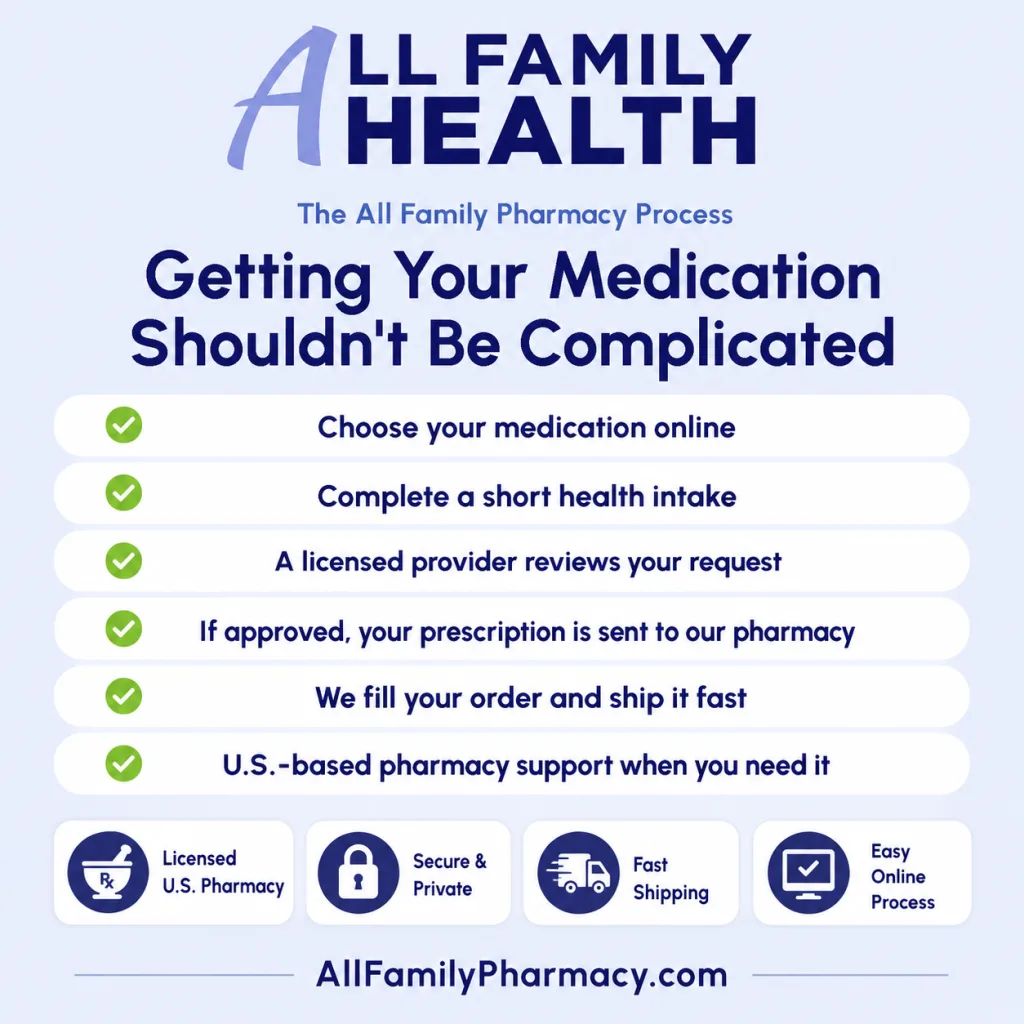
How It Works
- Step 1Choose TreatmentSelect your treatment and quantity.
- Step 2Complete Health QuestionsAnswer a brief medical intake.
- Step 3Provider ReviewA licensed provider reviews your information.
- Step 4Pharmacy ShipsIf approved, your prescription is filled and shipped.
What patients say
“So far very easy to use and good explanation”
“I LOVE being able to order online prescriptions as needed.”
“I have used All Family Health many times and have never been disappointed. They offer great service and great products.”
“Professional and secure. Safe and efficient process. Thank you!”
“Great Pricing and a great product”
“My order was very easy. Thank you.”
“Very easy to navigate the site”
“Prompt, professional organization.”
“Everything was so simple to do,I can't not be more happy with your business 😁”
“I'm happy I was able to get what I was looking for”
- A one-time provider review fee is added once per order, not per medication
- Transparent pricing with no surprise fees
- Packed and shipped in plain, unmarked packaging
- You only pay if a provider approves your order
- Eligible for HSA and FSA
Choose Your Treatment *
+ $30 provider review & $10 shipping
+ $30 provider review & $10 shipping
+ $30 provider review & $10 shipping
- Medication$40
- Provider review$30
- Shipping$10
- Total$80
Only charged if approved
Need another? Add more above — one $30 review + $10 shipping per order.
✓ In your cart
- Estimated delivery: Mon–Tue, Nov 23–24
See price breakdown
Estimated delivery: Mon–Tue, Nov 23–24
Refills at provider discretion.
- Step 1Choose TreatmentSelect your treatment and quantity.
- Step 2Complete Health QuestionsAnswer a brief medical intake.
- Step 3Provider ReviewA licensed provider reviews your information.
- Step 4Pharmacy ShipsIf approved, your prescription is filled and shipped.
Choosing and Using Your Treatment
| Treatment | Choose this if… | How to Take |
|---|---|---|
| Doxycycline Hyclate 100mg | First-line choice for most non-pregnant adults with early Lyme disease. | Take one capsule by mouth twice daily for 14 days. |
| Amoxicillin 500mg | A standard alternative for people who cannot take doxycycline, including during pregnancy when a provider recommends it. | Take 1 capsule by mouth three times daily for 14 days. |
| Cefuroxime 500mg | An alternative for those who cannot take doxycycline or amoxicillin. | Take 1 tablet by mouth twice daily for 14 days. |
What is Lyme Disease?
Also called: Lyme borreliosis
Lyme disease is caused by the bacterium Borrelia burgdorferi, which is carried by blacklegged ticks in many parts of the United States, especially the Northeast, mid-Atlantic, upper Midwest, and Pacific Coast. In most cases, a tick must be attached for 36 to 48 hours or more before the bacteria can be transmitted. The most recognizable early sign is an expanding circular rash called erythema migrans, which sometimes has a bull's-eye appearance, often accompanied by fever, fatigue, headache, and muscle or joint aches. If untreated, the infection can spread over weeks to months and affect the joints, heart, and nervous system. Early treatment with oral antibiotics is effective for most people, and prompt care lowers the risk of later complications. A provider will consider your symptoms, tick exposure history, and sometimes lab testing when deciding on treatment.
Common symptoms
- Expanding red rash (erythema migrans), sometimes with a bull's-eye appearance
- Fever and chills
- Fatigue
- Headache
- Muscle and joint aches
- Swollen lymph nodes
- Later stages: joint swelling, facial drooping, heart palpitations, or nerve pain
Causes & risk factors
- Bite from an infected blacklegged (deer) tick
- Ticks acquired in wooded, brushy, or grassy areas
- Tick attachment for roughly 36–48 hours or longer
- Outdoor activities such as hiking, camping, gardening, or hunting in endemic regions
- Living in or visiting the Northeast, mid-Atlantic, upper Midwest, or Pacific Coast regions
Treatment options for Lyme Disease
Compare the medications offered on this page. Your provider will choose the right one for you based on your answers.
Doxycycline Hyclate 100mg
from $40Tetracycline antibiotic
- Good choice if
- First-line choice for most non-pregnant adults with early Lyme disease.
- Typical dosing
- Take one capsule by mouth twice daily for 14 days.
Amoxicillin 500mg
from $60Penicillin-class antibiotic
- Good choice if
- A standard alternative for people who cannot take doxycycline, including during pregnancy when a provider recommends it.
- Typical dosing
- Take 1 capsule by mouth three times daily for 14 days.
Cefuroxime 500mg
from $40Cephalosporin antibiotic
- Good choice if
- An alternative for those who cannot take doxycycline or amoxicillin.
- Typical dosing
- Take 1 tablet by mouth twice daily for 14 days.
Prices are for the medication only. Provider review and shipping are shown at checkout.
When to see a doctor in person
Online treatment can be a good fit for early Lyme disease in adults — for example, a recent tick bite in a high-risk area with a classic erythema migrans rash and mild symptoms — after a licensed provider reviews your history. See a provider in person if symptoms have lasted weeks, the diagnosis is unclear, you are pregnant, or symptoms involve the joints or nervous system, since these situations may need an exam and lab testing. Seek emergency care right away for chest pain, a slow or irregular heartbeat, fainting, severe headache with a stiff neck, facial drooping, or difficulty breathing, as these can signal Lyme complications affecting the heart or nervous system.
Prevention & self-care
- Use EPA-registered insect repellent (such as DEET or picaridin) on skin
- Treat clothing and gear with 0.5% permethrin
- Wear long sleeves and pants and tuck pants into socks in tick habitat
- Walk in the center of trails and avoid tall grass and leaf litter
- Do a full-body tick check after being outdoors
- Shower soon after coming indoors
- Remove attached ticks promptly with fine-tipped tweezers
Lyme Disease FAQ
How do people get Lyme disease?
Lyme disease is spread through the bite of infected blacklegged (deer) ticks. In most cases the tick must be attached for about 36 to 48 hours before the bacteria are transmitted. It does not spread from person to person.
What does the Lyme disease rash look like?
The classic rash, called erythema migrans, starts at the site of the tick bite and expands gradually over days, sometimes reaching 12 inches or more. It may develop a bull's-eye appearance and is usually not itchy or painful. Not everyone with Lyme disease develops or notices a rash.
How is Lyme disease treated?
Early Lyme disease is treated with a course of oral antibiotics, most commonly doxycycline, amoxicillin, or cefuroxime. Most people who are treated early recover completely. The right antibiotic and length of treatment depend on your symptoms and health history, which a provider will review.
How soon after a tick bite should I get treated?
The sooner treatment starts, the better the outcome. If you develop a rash, fever, or flu-like symptoms within about 30 days of a tick bite, contact a provider promptly. In some cases, a single preventive dose of doxycycline may be considered shortly after a high-risk tick bite.
Can Lyme disease go away on its own?
Some early symptoms may fade without treatment, but the infection can remain and later cause problems in the joints, heart, or nervous system. Antibiotic treatment is recommended to clear the infection and reduce the risk of these complications.
Do I need a blood test before treatment?
Not always. If you have a classic erythema migrans rash after likely tick exposure in an area where Lyme disease is common, providers often treat without testing, because blood tests can be negative in the first weeks of infection. Testing is more useful for later-stage symptoms.
What is post-treatment Lyme disease syndrome?
A small percentage of people have lingering fatigue, aches, or difficulty concentrating for months after finishing antibiotics. The cause is not fully understood, and studies show that prolonged antibiotic courses do not help and can cause harm. Most people improve gradually over time; ongoing symptoms should be evaluated by a provider.
Is Lyme disease contagious?
No. Lyme disease does not spread through touching, kissing, coughing, or sexual contact. It is only transmitted through the bite of an infected tick.
How Lyme Disease Progresses Without Treatment
Lyme disease is usually described in stages. Recognizing which stage you may be in helps determine whether online care is appropriate or an in-person evaluation is needed.
| Stage | Timing | Typical Features |
|---|---|---|
| Early localized | 3–30 days after the bite | Expanding erythema migrans rash, fever, fatigue, headache, muscle aches |
| Early disseminated | Weeks to months | Multiple rashes, facial palsy, nerve pain, heart rhythm changes (Lyme carditis) |
| Late disseminated | Months or longer | Arthritis with joint swelling (often the knee), ongoing nerve symptoms |
Removing a Tick Safely
- Use fine-tipped tweezers to grasp the tick as close to the skin as possible.
- Pull upward with steady, even pressure — do not twist or jerk.
- Clean the bite area and your hands with soap and water or rubbing alcohol.
- Do not use heat, petroleum jelly, or nail polish to remove a tick.
- Note the date of the bite and watch the area for an expanding rash over the next 30 days.