
Order Psoriasis Treatment Online
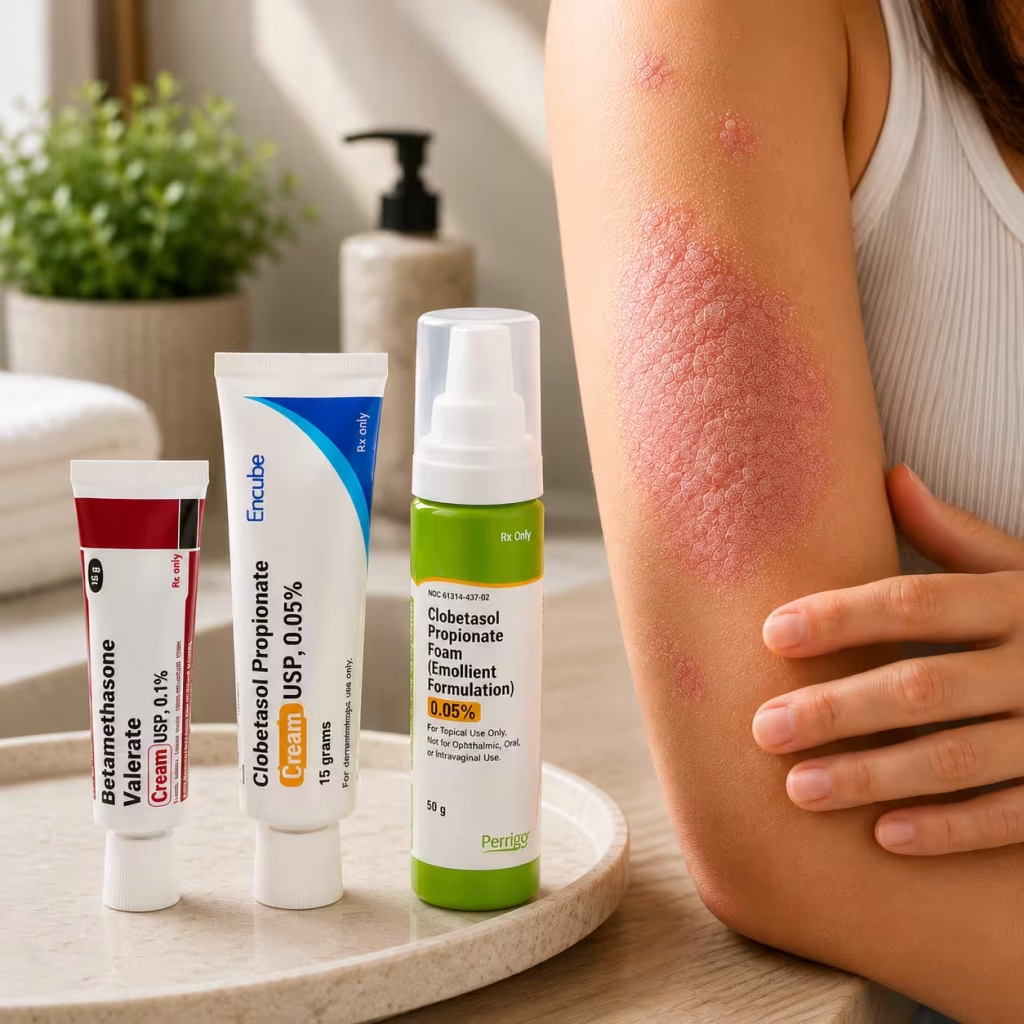
Commonly treated with Clobetasol, Betamethasone & Triamcinolone topicals
Medication as Low as $30.00



How It Works
- Step 1Choose TreatmentSelect your treatment and quantity.
- Step 2Complete Health QuestionsAnswer a brief medical intake.
- Step 3Provider ReviewA licensed provider reviews your information.
- Step 4Pharmacy ShipsIf approved, your prescription is filled and shipped.
What patients say
“So far very easy to use and good explanation”
“I LOVE being able to order online prescriptions as needed.”
“I have used All Family Health many times and have never been disappointed. They offer great service and great products.”
“Professional and secure. Safe and efficient process. Thank you!”
“Great Pricing and a great product”
“My order was very easy. Thank you.”
“Very easy to navigate the site”
“Prompt, professional organization.”
“Everything was so simple to do,I can't not be more happy with your business 😁”
“I'm happy I was able to get what I was looking for”
- A one-time provider review fee is added once per order, not per medication
- Transparent pricing with no surprise fees
- Packed and shipped in plain, unmarked packaging
- You only pay if a provider approves your order
- Eligible for HSA and FSA
Choose Your Treatment *
+ $30 provider review & $10 shipping
Refill up to 2 times without a new visit — fast processing.
+ $30 provider review & $10 shipping
Refill up to 2 times without a new visit — fast processing.
+ $30 provider review & $10 shipping
Refill up to 3 times without a new visit — fast processing.
+ $30 provider review & $10 shipping
Refill up to 3 times without a new visit — fast processing.
- Medication$110
- Provider review$30
- Shipping$10
- Total$150
Only charged if approved
Need another? Add more above — one $30 review + $10 shipping per order.
✓ In your cart
- Estimated delivery: Mon–Tue, Nov 23–24
See price breakdown
Refill up to 2 times without a new visit — fast processing.
Estimated delivery: Mon–Tue, Nov 23–24
- Step 1Choose TreatmentSelect your treatment and quantity.
- Step 2Complete Health QuestionsAnswer a brief medical intake.
- Step 3Provider ReviewA licensed provider reviews your information.
- Step 4Pharmacy ShipsIf approved, your prescription is filled and shipped.
Choosing and Using Your Treatment
| Treatment | Choose this if… | How to Take |
|---|---|---|
| Calcipotriene 0.005% Cream | You have plaque psoriasis with thick, dry, scaly patches and prefer a non-steroid topical treatment that helps slow excess skin-cell growth. Calcipotriene may be used alone or as part of a clinician-directed psoriasis treatment plan. | Apply a thin layer to the affected skin twice daily and rub in gently and completely. Wash hands after application. |
| Clobetasol Propionate 0.05% Foam | For scalp psoriasis, where a foam is easier to apply through hair. | Apply a thin layer topically to affected areas of the scalp twice daily for up to 2 weeks. |
| Betamethasone 0.1% Cream | For mild to moderate plaques on the body when a mid-potency steroid is appropriate. | Apply a thin layer topically to affected areas twice daily for up to 2 weeks. |
| Triamcinolone 0.1% Ointment | For ongoing maintenance of mild plaques or larger body areas needing a mid-potency option. | Apply a thin layer topically to affected areas twice daily. |
What is Psoriasis?
Also called: Plaque psoriasis
Psoriasis is a long-term (chronic) condition in which the immune system speeds up skin cell growth. Instead of shedding normally, skin cells pile up on the surface, forming raised, red or discolored patches covered with silvery scales. Plaque psoriasis is the most common form, but other types include scalp psoriasis, guttate psoriasis, inverse psoriasis, nail psoriasis, and pustular psoriasis. Symptoms often come and go in cycles, flaring for weeks or months and then improving. Psoriasis is not contagious — you cannot catch it from or spread it to another person. Treatment focuses on slowing skin cell turnover, reducing inflammation, and managing triggers.
Common symptoms
- Raised, scaly patches (plaques) with silvery-white scale
- Dry, cracked skin that may bleed
- Itching, burning, or soreness in affected areas
- Flaking and scaling on the scalp that can resemble dandruff
- Thickened, pitted, or ridged nails (nail psoriasis)
- Small, drop-shaped spots on the trunk or limbs (guttate psoriasis)
- Smooth, red patches in skin folds (inverse psoriasis)
Causes & risk factors
- An overactive immune system that speeds up skin cell production
- Genetics — psoriasis often runs in families
- Triggers such as stress, skin injury, or sunburn
- Infections, especially strep throat (a common guttate psoriasis trigger)
- Cold, dry weather
- Certain medications, including some blood pressure and antimalarial drugs
- Smoking and heavy alcohol use
Treatment options for Psoriasis
Compare the medications offered on this page. Your provider will choose the right one for you based on your answers.
Calcipotriene 0.005% Cream
from $110Topical vitamin D3 analog
- Good choice if
- You have plaque psoriasis with thick, dry, scaly patches and prefer a non-steroid topical treatment that helps slow excess skin-cell growth. Calcipotriene may be used alone or as part of a clinician-directed psoriasis treatment plan.
- Typical dosing
- Apply a thin layer to the affected skin twice daily and rub in gently and completely. Wash hands after application.
Clobetasol Propionate 0.05% Foam
from $40Topical corticosteroid
- Good choice if
- For scalp psoriasis, where a foam is easier to apply through hair.
- Typical dosing
- Apply a thin layer topically to affected areas of the scalp twice daily for up to 2 weeks.
Betamethasone 0.1% Cream
from $40Topical corticosteroid
- Good choice if
- For mild to moderate plaques on the body when a mid-potency steroid is appropriate.
- Typical dosing
- Apply a thin layer topically to affected areas twice daily for up to 2 weeks.
Triamcinolone 0.1% Ointment
from $30Topical corticosteroid
- Good choice if
- For ongoing maintenance of mild plaques or larger body areas needing a mid-potency option.
- Typical dosing
- Apply a thin layer topically to affected areas twice daily.
Prices are for the medication only. Provider review and shipping are shown at checkout.
When to see a doctor in person
Online treatment is a good fit for mild to moderate plaque or scalp psoriasis that has been diagnosed before, or for classic symptoms that a provider can evaluate with photos and your health history. See a doctor or dermatologist in person if plaques cover a large portion of your body, your nails or joints are affected (joint pain and stiffness may signal psoriatic arthritis), the rash looks infected, or topical treatments are not controlling symptoms — you may need light therapy or systemic medication. Seek emergency care for widespread redness, peeling, or pustules over most of the body accompanied by fever or chills, which can indicate erythrodermic or generalized pustular psoriasis, both medical emergencies.
Prevention & self-care
- Psoriasis itself cannot be prevented, but flares can often be reduced
- Keep skin well moisturized, especially in cold or dry weather
- Identify and manage personal triggers such as stress
- Avoid skin injury, scratching, and harsh scrubbing
- Limit alcohol and avoid smoking
- Treat infections like strep throat promptly
- Take medications consistently as prescribed to maintain control
Psoriasis FAQ
What is psoriasis?
Psoriasis is a chronic autoimmune condition in which the immune system causes skin cells to grow much faster than normal. The excess cells build up into thick, scaly patches called plaques. It typically cycles through flares and periods of improvement over a person's lifetime.
Is psoriasis contagious?
No. Psoriasis is caused by immune system activity and genetics, not by bacteria, viruses, or fungi. You cannot catch psoriasis from touching someone who has it, and you cannot spread it to others.
Is psoriasis an autoimmune disease?
Yes, psoriasis is considered an immune-mediated (autoimmune) disease. The immune system mistakenly triggers inflammation that speeds up skin cell turnover, causing cells to accumulate on the skin's surface as plaques.
How to cure psoriasis permanently?
There is currently no permanent cure for psoriasis. However, prescription treatments — including topical corticosteroids, light therapy, and systemic medications — can control symptoms very effectively, and many people achieve long stretches of clear or nearly clear skin. Consistent treatment and trigger management are key.
What causes psoriasis?
Psoriasis results from a combination of genetics and an overactive immune system. Flares are often set off by triggers such as stress, skin injury, infections like strep throat, cold dry weather, certain medications, smoking, or heavy alcohol use.
What does psoriasis look like?
Plaque psoriasis appears as raised, well-defined patches covered with silvery-white scale, often on the elbows, knees, scalp, and lower back. On darker skin tones, plaques may look purple, gray, or dark brown. Other forms can appear as small drop-like spots, smooth red patches in skin folds, or pus-filled bumps.
Scalp psoriasis vs dandruff — how can I tell the difference?
Dandruff causes fine, loose, white or yellowish flakes without significant inflammation. Scalp psoriasis causes thicker, well-defined scaly plaques that may extend beyond the hairline onto the forehead, neck, or ears, and the underlying skin is often raised and inflamed. If flaking does not improve with dandruff shampoo, psoriasis may be the cause.
Is psoriasis genetic?
Genetics play a significant role. Having a parent or sibling with psoriasis increases your risk, and researchers have identified multiple genes associated with the condition. However, many people with these genes never develop psoriasis — environmental triggers usually play a part as well.
Psoriasis vs. Eczema: What's the Difference?
Psoriasis and eczema can look similar, but they are different conditions with different treatments. A provider can usually tell them apart based on appearance, location, and history.
| Feature | Psoriasis | Eczema |
|---|---|---|
| Appearance | Thick, raised, well-defined plaques with silvery scale | Red, dry, sometimes weeping or crusted patches with less defined edges |
| Itch | Often itchy, may also burn or sting | Usually intensely itchy |
| Common locations | Elbows, knees, scalp, lower back, nails | Inside of elbows, behind knees, hands, face |
| Cause | Autoimmune overproduction of skin cells | Impaired skin barrier plus immune sensitivity and allergens |
Common Types of Psoriasis
- Plaque psoriasis — the most common type; raised, scaly plaques on the elbows, knees, scalp, and trunk.
- Scalp psoriasis — plaques on the scalp that may extend past the hairline and can be mistaken for severe dandruff.
- Guttate psoriasis — small, drop-shaped spots, often appearing after a strep infection, especially in children and young adults.
- Inverse psoriasis — smooth, shiny patches in skin folds such as the armpits, groin, and under the breasts.
- Nail psoriasis — pitting, discoloration, thickening, or separation of the nails.
- Pustular psoriasis — pus-filled bumps on red skin; widespread pustular psoriasis with fever requires urgent medical care.